Hey y’all! How’s it going? How many artists are in the room; show of hands? Alright, so this is the internet, and I can’t really see how many of you are out there, but I’m sure that it’s a hell of a lot!
Well, as so many of you are artists, you all know how important the internet, social media, instagram, etc. are to getting critical feedback, promoting exhibitions, as well as reaching and broadening your audience. The internet is arguably the most essential tool for any person trying build their creative practice in this day and age, but as I’m sure many of you know, there are major downsides to posting your work for all of the world to see.
Show of hands. How many of you have had your artwork copied, stolen, plagiarized, ripped off, knocked off and then sold off? Great, I still can’t see you, but just keep your hands raised for the duration of this article, ok? Thanks!

Grabbing Hands (Aggression/Submission), Screenprint Collage and Acrylic on Wood Panel, 2014
I know that the potential of intellectual theft is a massive problem with internet marketing because I too am a working artist who has had to deal with this very problem (hand raised). In 2014 I was working on a series titled “Grabbing Hands” that alluded to a certain American corporation that will be named, that for many people stands for the exploitative corporate materialism, homogenization of individual creative spirit, and the farcical whitewashed depiction the American Dream via white gloved cartoon animals for feel good thrills (despite the truly difficult reality that so many people face in this country.)
That’s right, I’m talking about McDonald’s. Just kidding, it’s Disney. For reals, it’s Disney. McDonald’s sells food or something…. I’m talking about Disney, the corporate person who owns Mickey Mouse. That Disney.
Anyways, so this artwork that I was making dealt with the loss of individuality amongst the group, the placid acceptance of unethical behavior as “just business”, and the yearning for the promised life that has been broadcast to us as Americans, but never seems to materialize. And so whenever I finished a painting, yeah you know, I posted that shit on Instagram and got like 80 likes (not bad, you know 80 Likes, not like gonna make my career but you know, 80 Likes am I right?)
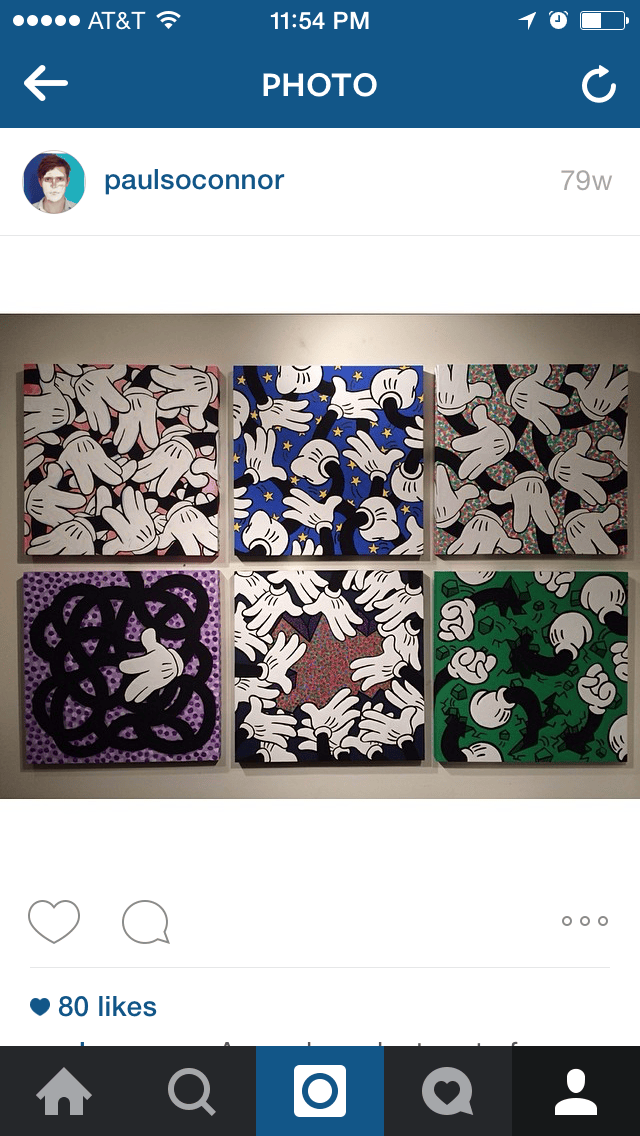
80 Likes. Noice Kid.
So you can imagine how surprised I was when a year and a half later, my friend texted me a photo of some official Disney merch put out by the French brand Eleven Paris that looks a hellovalot like the work I was doing. Not only did my designs end up on someone else’s products, but that type of appropriation was exactly the type of business practice that I was criticizing in the first place! The irony was tangible, like how when you breathe in the Nuts-4-Nuts vapor through your mouth and nose at the same time on a cold winters day you can actually taste the Nuts-4-Nuts, uh, nuts.

The Offending Material
Photo Credit: Roxanne Fequerre
But what’s a poor old working artist to do in this situation? You could go to a lawyer and say that Disney and their massive legal team took your idea and are now making cash/money off of your concept, but in what world can you expect to find justice in a system that favors those with practically infinite amounts of money when you can barely afford having a studio to work in on top of your Brooklyn studio apartment?
Or maybe you just stop posting your work online? Or slap on a shit ton of watermarks over your artwork if you do post an image? Well the former option isn’t going to work in our contemporary media environment where a cat yawning can go viral with 30 million views, and the latter is useless because any 12 year old with a cracked version of photoshop could remove that watermark in a matter of minutes. Plus a watermark isn’t going to protect you from imitating the concept of the artwork, even if the e-thief doesn’t use the original digital source imagery. There is no realistic recourse for an artist in this situation; you have to promote online and when the work gets stolen by a more powerful entity, the artist just has to stomach it.

Hey guy. Whats wrong?
Them’s the breaks, kid.
* * * * * * * *
I’m sure that there’s a portion of you sharply dressed, business oriented Millennials out there who have taken a look at my work in comparison to the Eleven Paris Disney Merch and thought to yourselves and all of Facebook, “Yeah, but Disney put in the work and capital to develop their brand, so it’s actually like, you who are like, infringing or whatever and like trying to capitalize on like their hard work and stuff”
A well stated point; but alas, a viewpoint in need of a good legal lesson.
In America, (AMERICA!), we have certain exceptions to the basic copyright laws that allow for the use of protected material without the permission of copyright owner; these exceptions include “purposes such as criticism, comment, news reporting, teaching (including multiple copies for classroom use), scholarship, or research” and are grouped under the term “Fair Use”. The purpose of this is to give academics, journalists, students, and artists the freedom (FREEDOM!) to discuss, critique, parody, reinterpret, and respond to existing ideas without the threat of legal prosecution. Free Use allows for open discourse that lets creativity and scholarship shift and evolve which ultimately is a benefit to our society as a whole, which is good because you know… Freedom. (AMERICA!)

(AMERICA!) (FREEDOM!)
As Fair Use applies to art and design, artists are free to appropriate copyrighted material under these broad (and mostly subjective) guidelines. Not to say that all of the guidelines must be met, but at least a few, or maybe just one. I’m artist, okay? Not a lawyer… Perhaps I squandered my potential? No time for regrets! Here are the guidelines:
1. The purpose and character of the work is substantially transformative
This means that the protected material that is used is altered in a way that changes the meaning/understanding of the original or adds new expressive aspects instead of being a literal copy
2. Whether the copyrighted work is of a factual or fictional nature
If you are taking from a factual source, there’s a better chance that the new work will fall under fair use because of the public’s right to factual information. And although you may feel that the public has a right to know how hot Edward from Twilight is, American courts see works of fiction as more protected than non-fiction.

Don’t believe what they say. Size DOES matter.
3. The amount of the copyrighted material used in relation to the whole of the original source
If an artist uses a copyrighted image in it’s entirety, or uses the “heart” of the image, it is more difficult to argue for fair use than if they were to use only a portion of the image. However, works of parody can often get away with the use of a larger portion, because the audience’s understanding of the original is crucial to their understanding of the parody.
4. Does the new work economically compete directly with the original or does it serve a different audience?
If the new work finds a different commercial niche than the original, the content is more likely to be considered fair use because it isn’t carving a share out of the market of the copyrighted work.
As you can see, the rules are pretty open to interpretation, which is why artists run into so much trouble these days in a post-modern (post-internet? post-instagram? post-raisin bran?) creative environment, where appropriation and the re-contextualization of existing images is such a popular and powerful tool. Big boy artists like Jeff Koons and Richard Prince get slapped with lawsuits all the time for questions of Fair Use and as a society, we are still deciding as a society where the lines of fair use are drawn…
But back to the question of whether my work meets Fair Use… I’d argue it does, because the amount taken from the original material was just a portion, and was not the “heart” of the image. From that portion of material, I created a different, distinct aesthetic, that addresses larger themes that both criticize and mock the original material; it was transformative in both appearance and understanding of the source. Also, Disney does put out Official Disney fine art, but I don’t think that they have to worry about market competition from me. My work doesn’t really appeal to the Thomas Kinkade crowd.
* * * * * * * *


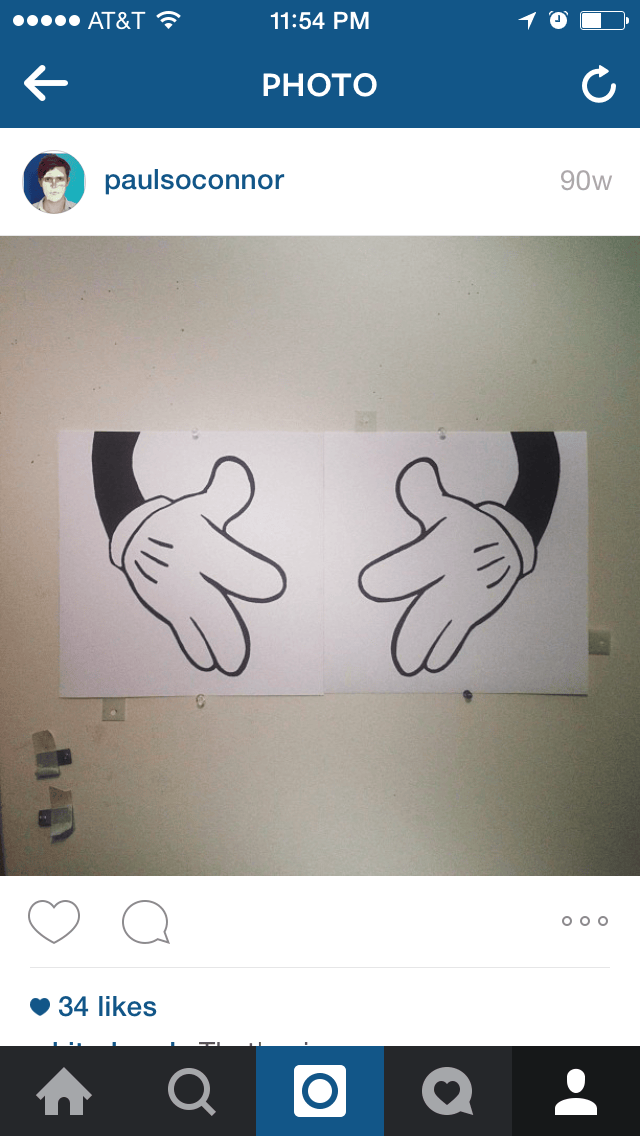

But how does the Paris Eleven / Disney pattern stand up to the same set of criteria? If my work were to be considered as the original, copyrighted source material, could Disney make the argument for fair use?
1. The purpose and character of the work is substantially transformative:
If I just shown you all the works (both Disney and mine) in isolation, without outside context, would there be a clear distinction between the designs? Does the Disney pattern alter the aesthetics of the image enough to be considered transformative? Are they adding any additional meaning to their work?
2. Whether the copyrighted work is of a factual or fictional nature
Fictional. Duh. That shit ain’t real dummy.
3. The amount of the copyrighted material used in relation to the whole of the original source
In this instance, I don’t think that any of my original material was directly copied. However, was the “heart” of the image copied? Was the core concept of the design copied?
4. Does the new work economically compete directly with the original or does it serve a different audience?
While I never used those specific designs on apparel, I do make repeating patterns that I use on clothing and accessories. Does their clothing cut into my potential market?
You’re free to make up your own mind as to the answers of these questions, but in my personal opinion (and I know that I am a biased party in this instance), FUCK THAT SHIT! I’m getting ripped off by Disney! Assholes! Can’t they afford to pay someone to make designs for them? But that’s my own opinion which may or may not be biased, I mean, who am I to say…


And again, there is little that an independent artist can do when their work gets taken by a multi-national corporation (it’s not a David and Goliath situation; it’s a Woody Allen vs Goliath situation. Shit is so beyond hopeless.) Really, the only thing that an artist can do is call the offender out on their bullshit and hope that other people hear it, because if enough people do hear, I think that you actually can make a difference.
When someone steals your artwork and sells it as their own, any sales justify the behavior and encourage more theft. But if no one buys the offending object and consumers outwardly make the point that they know that the design is stolen, there is a financial and social disincentive to pilfer someone else’s creative work. Just like in middle school, peer pressure works!
Also, with the sheer number of things available online and the constant stream of new products, there is no way for any artist to effectively monitor whether their designs are being unfairly used. But when we see something that we think might be shady, and we go the extra mile to inform the artist that their work has been taken by someone else, it goes a long way to enabling us to react to the situation.
That is why all the artists with their hands still raised (you can put them down now) and myself would like to make a plea to you that during Black Friday, Small Business Saturday, Cyber Monday all the rest of the days in this glorious season of wanton materialism and spending, take an extra moment to do some due diligence about the creative source about your purchases. And don’t be afraid to let any artist know when you think that their work is being unfairly resold, in other words, “If you see something, Say Something” (Thanks MTA.) The acts of each individual may seem small, but if we all act a little more ethically as consumers, we do have the potential to support the small fry, independent artists who so frequently have to struggle to get paid for their work. I promise you that we all appreciate it very much.

Merry Christmas!
Happy Holidays!